
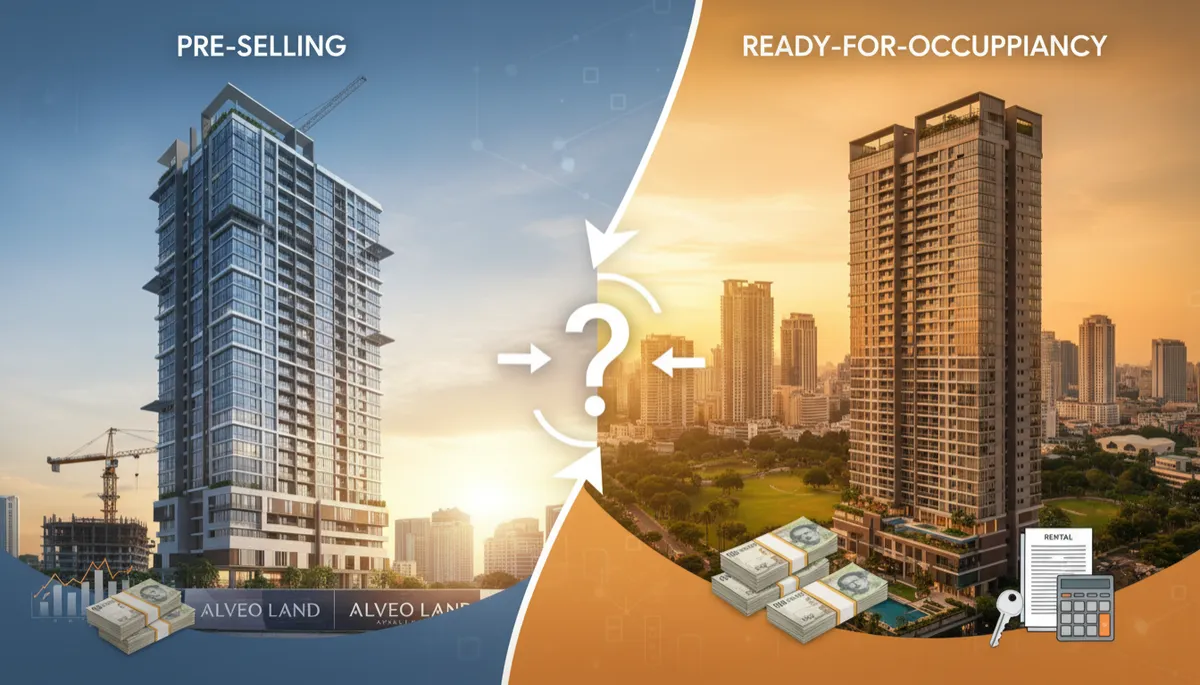
How to Finance a Pre-Selling Condo in Taguig: Bank Loan, Pag-IBIG or In-House (2026)
Financing is where most pre-selling condo decisions are won or lost. For a pre-selling condo in the Philippines, you can usually combine a staged down payment during construction with a long-term loan at turnover, and the loan source you choose (a bank, Pag-IBIG Fund, or the developer's own terms) can change your total interest by several million pesos. This guide compares the three routes for Ayala Land and Alveo Land buyers looking at Taguig real estate, with sample computations, OFW tips and the checks that matter before you reserve.
1. Which financing route fits a pre-selling condo: bank, Pag-IBIG or in-house?
For most buyers, a bank loan or a Pag-IBIG loan costs far less over time than developer in-house financing, but each has different limits on loan size, borrower type and speed. The right choice depends on your income documents, your residency status, and the price of the unit.
- Pag-IBIG Fund: government-backed, with the lowest published rates and a loan ceiling of up to ₱10 million per member, up to 30 years to pay, and up to two co-borrowers, according to the fund's housing loan page.
- Bank loan: generally the most flexible for higher-priced units because lenders size the loan to income and appraisal rather than a fixed cap; banks commonly lend up to about 80% of the appraised value.
- In-house or direct payment terms: convenient and often faster, but reported market rates for developer in-house financing run roughly 12% to 18% per year, so they are usually used for short balances rather than the full price.
2. How does payment work during pre-selling?
In a typical pre-selling structure, you pay a reservation fee, then a down payment spread over the construction period, and settle the balance through a loan or cash when the unit is ready for turnover. Exact percentages and schedules differ by project and unit, so ask for the written payment scheme before you reserve.
This staging is the main advantage of buying pre-selling: your cash outlay is spread over months or years, while your income and savings grow. It is also the main risk window, because your financing approval will be assessed near turnover, not on the day you reserve. If your income, employer or visa status could change before then, build a buffer. A sensible rule is to confirm your loan route early, then re-confirm it about a year before the expected turnover date.
3. How much can you borrow from Pag-IBIG: up to ₱10 million?
Pag-IBIG Fund currently advertises housing loans of up to ₱10 million per member, payable over up to 30 years, for condominium units from accredited developer projects. The loan term cannot go beyond age 70, and your approved amount is the lowest of the appraised value, the loan-to-value limit, and what your income can support.
Commonly cited requirements include active membership with at least 24 monthly contributions, age 65 or below at application, and a monthly amortization that does not exceed about 35% of gross monthly income. Published rates in 2026 have ranged from about 5.75% to 9.75% depending on the fixing period, with temporary promotional rates available for applications filed until the end of December 2026. Confirm the live figures with Pag-IBIG Fund before you apply.
For OFWs, Pag-IBIG can be handled through overseas channels, an accredited developer, or a representative in the Philippines holding a properly executed Special Power of Attorney (SPA). Because the ceiling now covers many Taguig condo prices, it deserves a serious look even for higher earners, particularly if you want a longer term. Note that Pag-IBIG is for qualified members; foreign nationals who are not members cannot use it.
4. When does a bank loan make more sense for a high-income buyer?
A bank loan makes more sense when the unit price exceeds what Pag-IBIG can finance, when you want a faster approval, or when your income is strong but irregular. Company owners, upper management, doctors and lawyers often fall into this group.
Banks typically look at your credit history, existing debts and proof of income. Employees submit payslips and certificates of employment; business owners and professionals usually provide income tax returns, audited financial statements and bank statements covering several months. Politicians and other public officials should expect enhanced source-of-funds questions under anti-money-laundering rules, so keep clean records of your income and the origin of your down payment.
Bank rates are repriced after an initial fixed period, so a loan that looks cheap for the first one to three years can reset higher. Ask each bank for the fixed-period rate, the repricing basis, any prepayment charge, and the total fees at closing. Comparing two or three banks is worth the effort: on an ₱8 million loan, a difference of one percentage point can change the monthly payment by several thousand pesos.
5. Is in-house financing worth the higher interest?
In-house financing is worth it only for short balances or when speed matters more than cost, because its published market rates are usually well above bank and Pag-IBIG pricing. It can also be the practical route when a bank has not yet approved a buyer, for example a non-resident foreign buyer.
Ask the sales team whether any direct payment terms are available for your chosen unit, and request them in writing alongside the bank and Pag-IBIG alternatives.
6. What does an ₱8 million loan really cost? A side-by-side computation
An ₱8 million loan costs between about ₱46,700 and ₱124,200 a month depending on rate and term, and total interest can range from roughly ₱3.2 million to ₱8.8 million. The table below uses illustrative, constant rates (real loans reprice) for a ₱10 million unit financed at 80%.
| Scenario (illustrative) | Rate | Term | Monthly payment | Total interest |
|---|---|---|---|---|
| Pag-IBIG-style loan | 5.75% | 30 years | ≈ ₱46,700 | ≈ ₱8.8 million |
| Pag-IBIG-style loan | 5.75% | 20 years | ≈ ₱56,200 | ≈ ₱5.5 million |
| Bank loan | 6.5% | 20 years | ≈ ₱59,600 | ≈ ₱6.3 million |
| Bank loan | 7.5% | 20 years | ≈ ₱64,400 | ≈ ₱7.5 million |
| In-house terms | 14% | 10 years | ≈ ₱124,200 | ≈ ₱6.9 million |
Three lessons stand out. First, a longer term lowers the monthly payment but raises total interest, so prepay when you can. Second, a 14% in-house rate on a 10-year term produces a monthly bill more than double the 30-year Pag-IBIG-style payment. Third, under the 35% rule, a ₱46,700 payment implies a gross monthly income of roughly ₱133,000, which is a quick way to test your borrowing capacity before applying.
If you are buying as an investment property in the Philippines, compare the loan rate with your expected net rental yield. Net yield is annual rent minus vacancy, association dues, maintenance and taxes, divided by your total cost. If your borrowing rate is higher than your net yield, the shortfall is paid from your income and you are relying on property appreciation, which is never guaranteed. Run a conservative case before you commit.
7. Can OFWs and foreigners finance a condo from abroad?
Yes for many OFWs, and sometimes for foreigners, but the route differs. OFWs who are Filipino citizens can usually apply for Pag-IBIG or bank financing with documents from abroad and a representative holding an SPA. Foreign nationals face tighter rules on both ownership and lending.
On ownership, the Condominium Act (Republic Act 4726) allows foreign nationals to own condominium units, but foreign ownership in a condominium project is capped at 40%, so at least 60% must be held by Filipinos. You receive a Condominium Certificate of Title (CCT) in your name. Because the cap is tracked per project, ask the sales team for the project's current foreign-ownership status in writing before paying a reservation fee. Foreigners cannot own land directly.
On lending, reports differ: some banks lend to foreign residents with a long-term visa, a Philippine TIN and a larger down payment (often cited at 20% to 30%), while others rarely lend to non-resident foreigners. Many foreign buyers therefore rely on cash, home-country equity or developer payment terms. Confirm with each lender directly.
This is where a Zoom site visit helps. You can ask the Alveo team to walk you through the project on camera, then pair that with a document checklist for your buyer type. Combined with a remote reservation and SPA, OFW property buyers and overseas investors can buy property from abroad without flying in for every step.
Next step: request a dated price list, written payment scheme and a Zoom site visit for the unit you are considering. Verify that the project holds a DHSUD License to Sell, and transact only with PRC-licensed real estate brokers or salespersons. Seek independent legal advice on ownership and signing authority before transferring funds.
8. Why does Arca South, Taguig suit a financed purchase?
Arca South suits financed buyers because it is a 74-hectare Ayala Land estate in Taguig, roughly 5 kilometers from BGC and NAIA and about 7 kilometers from the Makati CBD, so it offers location depth that lenders and renters both understand. For anyone searching condo for sale in Arca South or wider Taguig real estate, these are the Alveo Land communities to compare, based on the developer's published project pages:
- Park Cascades on East Union Drive, Western Bicutan: studio to 3-bedroom units from 28 to 114 sqm.
- The Veranda on Caliraya Drive: studio to 3-bedroom units from 29 to 147 sqm, in a low-density, four-tower mid-rise setting.
- Arbor Lanes on Nexus Street: garden suites to garden villas from 62 to 257 sqm.
- Gardencourt Residences: 1-bedroom to 3-bedroom suites from 69 to 217 sqm.
Unit size matters for financing. A 28 sqm studio and a 257 sqm garden villa sit in very different loan brackets, so decide your use case first: a home for family, a rental unit, or a long-term hold. Availability, pricing and project status change, so confirm which projects are still in pre-selling before you plan around them.
9. What should you check before you commit to financing?
Before you commit, check five items: the project's DHSUD License to Sell, the written payment scheme, your loan pre-qualification, the foreign-ownership status if you are not a Filipino citizen, and the total closing costs. Closing costs such as documentary stamp tax, transfer fees and registration are often budgeted at several percent of the price, so ask for an itemized estimate.
If you are ready to compare financing for a specific Alveo Land or Ayala Land project, book a Zoom site visit and ask for a project-specific financing checklist. Confirm the DHSUD License to Sell for the project, deal with PRC-licensed real estate brokers, and have your lawyer review the contract before you pay.
10. Frequently asked questions
Can I use Pag-IBIG to buy a pre-selling condo?
Yes, if the project is accredited and you meet the membership and income requirements. Pag-IBIG applications are generally filed near turnover, so confirm the project's accreditation and the current rates before relying on it.
Is a bank loan or Pag-IBIG cheaper?
Pag-IBIG usually publishes lower rates, but loan size, term and income rules vary. Compare the total cost for your own numbers, not only the headline rate.
Can a foreigner get a mortgage for a condo in the Philippines?
Sometimes. Some banks lend to foreign residents with the right visa and a larger down payment; many foreign buyers use cash or developer payment terms. Foreign ownership in the project must stay within the 40% cap.
How much down payment do I need?
It depends on the project and your financing route. Pag-IBIG commonly requires 5% to 10%, banks often fund up to 80%, and foreign buyers may be asked for 20% to 30% or more. Request the exact scheme in writing.
Does pre-selling guarantee appreciation or rental income?
No. Property appreciation and rental yield depend on location, timing and market demand, and neither is assured. Plan your financing so you can hold the unit through a weaker market.
This article is general information, not legal or financial advice. Rates, ceilings and project availability change; verify current figures with the lender or Pag-IBIG Fund and obtain independent professional advice before committing.
